
haze · air quality · ceiling fans · 6 min read
Haze in Singapore: health effects, and how a ceiling fan helps indoors
What PM2.5 haze does to your health, and the honest indoor setup: a fan doesn't filter PM2.5. But with the windows shut, it's what keeps a sealed flat liveable for cents a day. The honest haze setup, with the fan plus purifier pairing and the 26°C aircon trick.
By the Hai Guan Seng team, the folks behind the counter on Jalan Besar · 14 Oct 2026
Let us be upfront, because plenty of sellers won't be: a ceiling fan does not filter haze. It cannot remove PM2.5 from your air. Nothing with blades can. So why are we writing this? Because the standard haze advice, close your windows and stay indoors, creates a second problem that nobody warns you about. Your flat turns into a hot, airless box. That is the problem a fan actually solves, and it solves it for cents a day.
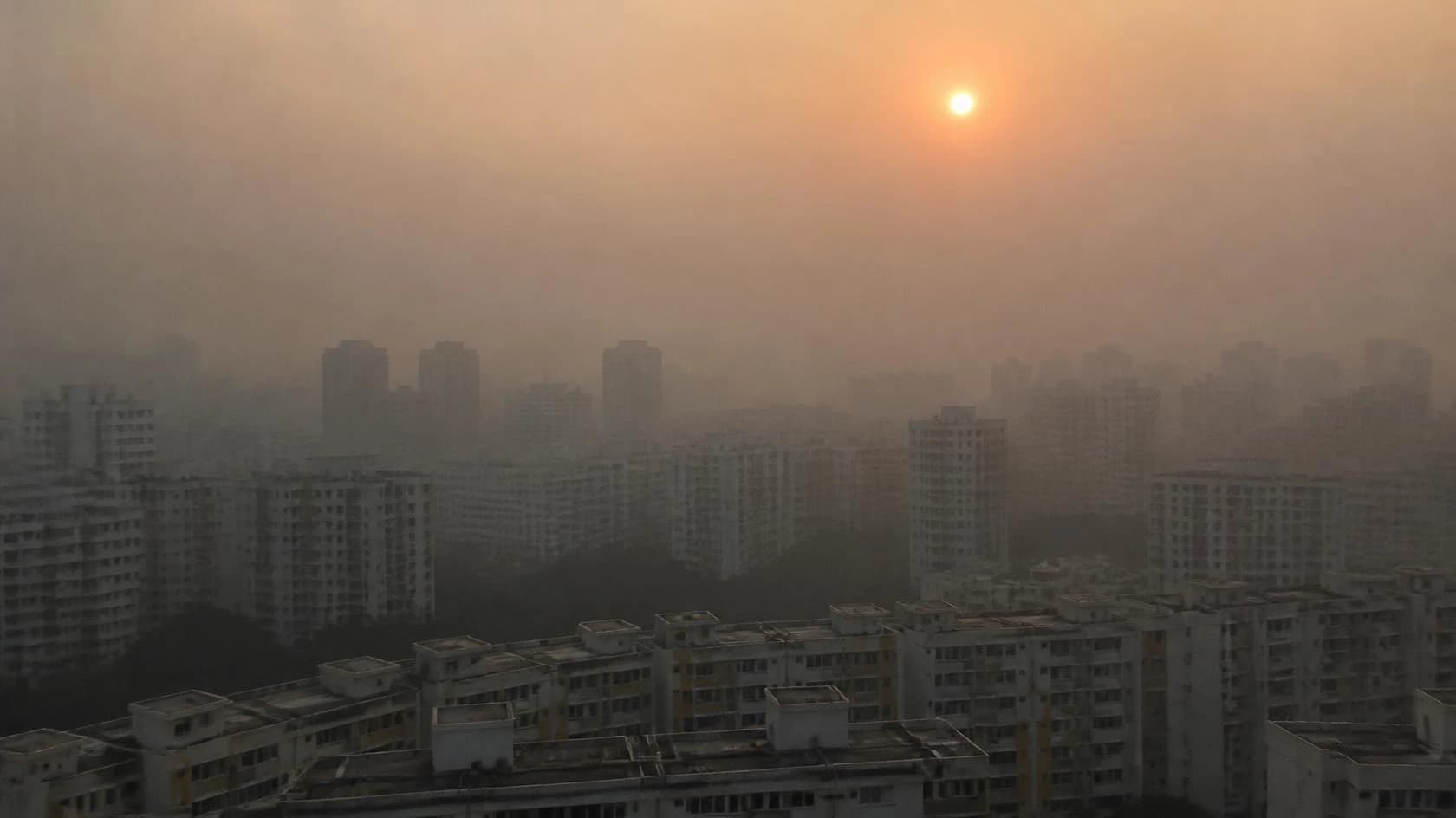
The haze playbook, in the right order
- Close windows and doors when the air turns bad, and open them up again once it improves. That is standard NEA and HealthHub guidance.
- Run an air purifier if you have one. That is the machine that actually removes particles.
- Use the ceiling fan to make the sealed room liveable, and to spread the purifier's clean air around instead of letting it sit in one corner.
The fan is step three, not step one. But in a Singapore flat with every window shut, step three is the difference between a bearable week and a miserable one.
What haze actually does to your health
Haze is mostly PM2.5, particles so fine they get past your nose's defences and reach deep into the lungs. The smallest ones pass into the bloodstream. That is why the PSI number matters more than how the sky looks from your window.
- Most people feel it as stinging or watery eyes, runny nose, scratchy throat, a dry cough, and feeling more tired than usual after going out.
- It hits harder if you have asthma, COPD or other lung conditions, or heart disease. Every haze period, these act up.
- Watch the vulnerable ones first: young children, the elderly, pregnant women, and anyone with chronic illness. They should be indoors before anyone else.
- Long stretches of heavy exposure strain the lungs and the heart. The advice to cut outdoor exertion exists for a reason. Don't tough it out.
Follow NEA's health advisories against the 24-hour PSI. Once the air is in the Unhealthy range, cut down prolonged or strenuous outdoor exertion, and the vulnerable groups should minimise it. On masks, MOH's guidance is specific: an N95 is for people who must be outdoors for several hours when the air is very bad (healthy adults at Hazardous levels, the vulnerable groups above PSI 200). Short trips like the walk to the MRT don't need one, indoors doesn't need one, and a surgical mask doesn't block PM2.5 at all. If a cough or breathlessness carries on after the haze clears, go and see a doctor. We are a hardware shop, not a clinic, and this article is practical advice, not medical advice.
Indoors, the three steps above are your protection. Closed windows cut how much PM2.5 gets in. The purifier removes what still does. The fan keeps that sealed, cleaner air liveable. Each layer does its own job. None of them replaces the others.
Why a closed-up flat needs moving air
Your body cools itself by sweating, and sweat only works when air moves across your skin. Seal up a room and the air goes completely still, so even 30 degrees feels oppressive. A ceiling fan puts the airflow back. Moving air makes your skin feel two to four degrees cooler than what the thermometer says, without opening a single window.
Low to medium speed is enough in a closed room. The top speeds just add noise, and during haze they can kick up the fine dust that has settled on your shelves. Slow and steady does the job.
Fan plus purifier: the pairing that actually works
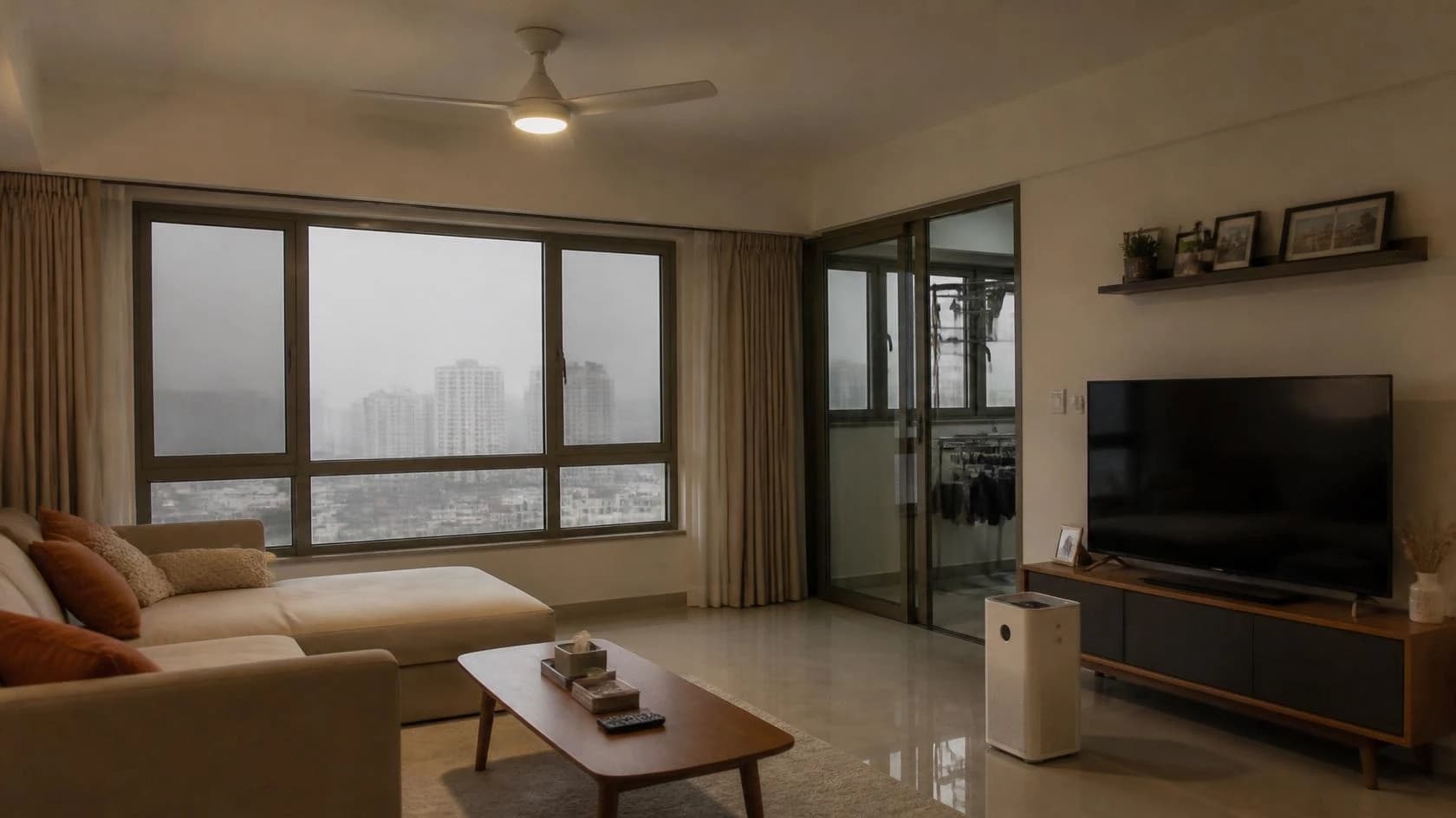
An air purifier cleans the air around itself. Its own small fan takes a long time to turn over a whole living room, so the clean air tends to pool next to the machine. A ceiling fan on low speed keeps the room gently mixing, so the cleaned air actually reaches the sofa and the bed. Purifier cleans, fan distributes. Each one doing the job it was built for.
One placement tip. Don't aim a strong downdraft straight at the purifier. You want the room stirring slowly, not a wind tunnel confusing its sensor.
The aircon question, and the 26 degrees plus fan trick
Haze week is when many households end up running the aircon from morning to night, since the windows are shut anyway. It works, but you will feel it on the bill. A few dollars a day, per room. A DC ceiling fan on low speed draws 3 to 5 watts. That is cents a day even running round the clock.
Here is what most of our customers settle on: set the aircon to 26 degrees and run the fan at the same time. The moving air does the "feels cooler" work, the compressor works much less, and the room feels like 23 degrees without the 23-degree bill. Or skip the aircon in the daytime and let the fan carry the closed-window hours on its own. Our running-cost guide has the exact numbers for both options.
Haze-mode setup, room by room
- Living room: windows shut, purifier on, ceiling fan on low to medium the whole day. Aircon only when the afternoon heat really demands it, at 26 degrees, with the fan running.
- Bedrooms at night: fan on low, with the timer or all night. DC fans are near silent on low speed, and that bit of airflow is what lets you sleep in a sealed room.
- Kitchen: cooking in a sealed flat builds up fumes fast. Use the hood, keep the kitchen door closed while frying, and let the fan settle the room after.
- After the haze clears: open everything and air the flat out, then wipe the fan blades, top and bottom. Haze dust settles unevenly, and that is the classic reason a wobble shows up a few weeks later.
On health, plainly: for the air itself, follow NEA's advisories. Stay indoors when the PSI is high, close up, and let a purifier do the filtering. The fan is for comfort and circulation. If anyone at home has a respiratory condition, the purifier comes first.
If haze week exposed a weak fan
Running a fan all day for a week is an honest stress test. If yours hummed, wobbled or barely moved air on low speed, it is telling you something. Our guides on fan noises and when to replace will tell you honestly whether it is a ten-minute fix or the end of the road.
And if it is time to change: the S$400 NEA Climate Voucher covers a new DC fan and the basic installation outright on more than 50 models in our shop. A quieter fan that costs 70% less to run, for S$0, is about the best haze-season upgrade there is. If you are also picking up the rest of the haze kit, LED bulbs, an extension point, a stand fan for the purifier corner, CDC vouchers can be spent on everything in our store, and they stack with the Climate Voucher in the same visit.
Setting up for haze season?
Tell us your flat type and which rooms you are sealing up. We will recommend the right fan sizes, what speed to run them at, and whether your voucher makes the upgrade free.
Ask the counterHealth guidance in this article follows the official advisories: NEA's haze FAQs (nea.gov.sg), HealthHub's "How to Protect Yourself Against the Haze" (healthhub.sg) and MOH's haze and mask guidance (moh.gov.sg). Check the myENV app or nea.gov.sg for the latest PSI before you plan your day. Fan specifications and running costs are from the manufacturers' data for models we stock.
Haze and fan questions
How does haze affect my health?
Haze is mostly PM2.5. These particles are fine enough to go deep into the lungs, and the smallest ones get into the bloodstream. Most people feel it as stinging eyes, runny nose, scratchy throat, cough and tiredness. It is worse for anyone with asthma, lung or heart conditions, and for young children, the elderly and pregnant women. Follow NEA's PSI advisories, keep the vulnerable ones indoors with windows closed, and see a doctor if the cough stays after the haze clears.
Does a ceiling fan filter haze or PM2.5?
No. We sell fans and we will still tell you straight: a fan moves air, it does not clean air. Filtering fine particles needs a proper HEPA air purifier. During haze the order is simple. Close the windows, run the purifier if you have one, then use the fan to keep the closed-up room comfortable and spread the clean air around.
Should I run my ceiling fan during haze with the windows closed?
Yes, that is exactly when it is most useful. Once the windows are shut, the air in the room goes completely still and it feels stuffy very fast. Moving air makes your skin feel two to four degrees cooler, so a fan on low or medium keeps a sealed room liveable. No need for the highest speed. It is noisier, and it can stir up the fine dust that settles during haze.
How do I use a fan together with an air purifier?
Purifier cleans, fan distributes. Run the purifier as usual, and set the fan to low speed so the cleaned air gets mixed around the whole room instead of staying in one corner. Just don't point strong airflow straight at the purifier. Gentle circulation is enough.
Is it expensive to run a ceiling fan all day during a haze period?
A DC ceiling fan on low speed uses about 3 to 5 watts. Even if you run it 24 hours a day for the whole haze week, you are looking at one or two dollars for the entire week at current SP rates. Running the aircon all day with the windows shut can cost a few dollars per day, per room. Big difference.
What should I do with my fan after the haze clears?
Open up the flat and air it out, then wipe the fan blades, top and bottom. Haze leaves a fine layer of dust and it never lands evenly. An uneven blade is the number one reason a fan starts wobbling a few weeks later. Ten minutes with a cloth saves you the trouble.
From our shelves
Fans mentioned in this guide
Authorised dealer stock, full warranty, Climate Voucher accepted on every DC model at the counter.

Fanco
Fanco B-Star DC Ceiling Fan with LED
DC

Fanco
Fanco Galaxy 38" / 48" / 56" DC Ceiling Fan
DC

Fanco
Fanco Rito-3 46" / 52" DC Ceiling Fan
DC · WiFi

Bestar
Bestar Falcon DC Ceiling Fan
DC

Point One
Point One Cyclone RS V-Spec IV (3-blade) 46" / 52" / 60" DC Ceiling Fan
DC

Point One
Point One Cyclone RS V-Spec IV (5-blade) 48" / 62" DC Ceiling Fan
DC

Alaska
Alaska Hydsen 35" / 46" / 52" DC Ceiling Fan
DC

Alaska
Alaska Starason 48" / 56" DC Ceiling Fan
DC

Alaska
Alaska Aspen III 38" / 50" DC Ceiling Fan
DC
Sorted? If not, ask the counter.
44 years of these questions at 31 Kelantan Lane. WhatsApp us what you are dealing with. A photo or a short video helps. We will tell you straight what it needs, whether or not it means buying anything.