
troubleshooting · ceiling fans · buying · 7 min read
When to replace your ceiling fan (and when not to)
Five signs a ceiling fan is genuinely finished, three that don't mean what people think, and the repair-or-replace rule we use at the counter.
By the Hai Guan Seng team, the folks behind the counter on Jalan Besar · 25 Jun 2026
People usually ask us this after living with a noise for six months. The honest answer is that most ceiling fans get replaced later than they should — not because they fail outright, but because they slowly get louder, wobblier and more expensive to run, and nobody notices the drift.
Here are the signals that actually mean something, and the ones that don't.
Five signs it's genuinely time
1. Grinding, rumbling or a rough hum
The clearest signal on the list. That sound is worn motor bearings, and on a domestic ceiling fan the bearings aren't an economically serviceable part — the labour to open the motor exceeds what the fan is worth. Once a fan grinds, it's at end of life. See our guide to fan noises if you're not sure which sound you have.
2. A wobble that won't stay fixed
Cleaning and balancing should hold for years. If you balance it and it drifts out again within weeks, the blades are warped or a holder is bent out of true — common on older timber blades in Singapore humidity. You can keep chasing it, but you're managing a fault rather than fixing one.
3. It's an AC fan and your bill matters
This one has no drama attached — the fan works fine. But an AC motor uses roughly three times the electricity of a DC motor for the same airflow, and a ceiling fan in a Singapore living room runs a great many hours a year. Over the remaining life of an old fan, that difference is real money.
4. You're renovating anyway
If the ceiling is being painted or the electrical points touched, replacing then costs a fraction of doing it as a separate job later — the installer is already there and the ceiling is already exposed. Doing it “next year” usually means paying twice.
5. Blades sagging, discoloured or delaminating
Timber and MDF blades absorb moisture over years. Once they sag or the veneer lifts, they can't be balanced reliably and the fan will never run smooth again.
And three that don't mean replace
- Age by itself. A quiet, steady twelve-year-old fan owes you nothing. Leave it alone.
- A dead remote. Usually batteries or pairing — see the remote guide. A spare remote is a cheap part.
- One-off wobble or click. Nearly always dust or a loose screw. Ten minutes, no money.
Repair or replace: the quick test
Our rule of thumb at the counter: if the fix is a screw, a clean, a blade holder, a remote or a receiver on a fan under about five years old — repair it. If the fix involves the motor, the blades themselves, or a fan over ten years old, replace it.
The reason we can be relaxed about telling you to repair is that we'd rather you trust us than buy a fan you don't need. Plenty of people walk out of our shop having spent nothing.
Why replacing costs less than usual right now
If you have concluded it's time, the timing is unusually good. The NEA Climate Voucher gives every Singapore household S$400 towards an energy-efficient DC ceiling fan. Because it covers the fan and our basic installation, any model priced at S$360 or below works out completely free, fitted — we have 51 of them.
Two caveats we'd rather you hear from us than discover later: the voucher covers a basic installation (a straight swap on an existing fan point, concrete ceiling up to 3m), with extras like a false ceiling or new wiring quoted separately; and it expires 31 December 2027. Installer slots tighten well before deadlines.
Not sure which side of the line you're on?
Send a short video of the fan running, plus roughly how old it is. We'll tell you straight whether it's a ten-minute fix or genuinely worth replacing — and if it's the latter, what it would cost you after the voucher.
Ask us: repair or replace?Repair-or-replace questions
How long does a ceiling fan last in Singapore?
A decent ceiling fan runs for ten to fifteen years here, and many older AC fans go longer. Humidity is the local factor: it warps timber blades and shortens bearing life compared with drier climates. Age alone isn't a reason to replace — a quiet, steady twelve-year-old fan is fine. Noise, wobble that won't stay fixed, or a big electricity bill are the real signals.
Is it worth replacing a working AC fan with a DC one?
On running cost alone, usually yes over a few years — a DC motor uses roughly 70% less electricity for the same airflow. But the honest reason most of our customers do it is noise: DC fans hold low speeds without the hum, which people notice most at night. With the Climate Voucher covering up to S$400, the sums are unusually favourable right now.
Which faults are worth repairing rather than replacing?
Loose screws, dusty blades, a bent blade holder, a dead remote or a failed receiver on a newer fan are all worth fixing — they're cheap parts or no cost at all. What isn't worth repairing is worn motor bearings (the grinding or rumbling noise), warped blades, or a fan that won't stay balanced after a proper balancing attempt.
Can I use the Climate Voucher to replace an old fan?
Yes — it's for any eligible DC ceiling fan, whether it's your first or a replacement. Each household gets S$400, claimed on Singpass through RedeemSG, redeemed in person at our counter. It expires 31 December 2027 and can't be used online.
What do you do with the old fan?
Our installers take the old fan down as part of the job and can remove it for you. If you'd rather dispose of it yourself, ceiling fans go to e-waste recycling rather than the rubbish chute — there are collection points across the island under the national e-waste scheme.
From our shelves
Fans mentioned in this guide
Authorised dealer stock, full warranty, Climate Voucher accepted on every DC model at the counter.

Bestar
Bestar Duo Hagar DC Ceiling Fan
DC
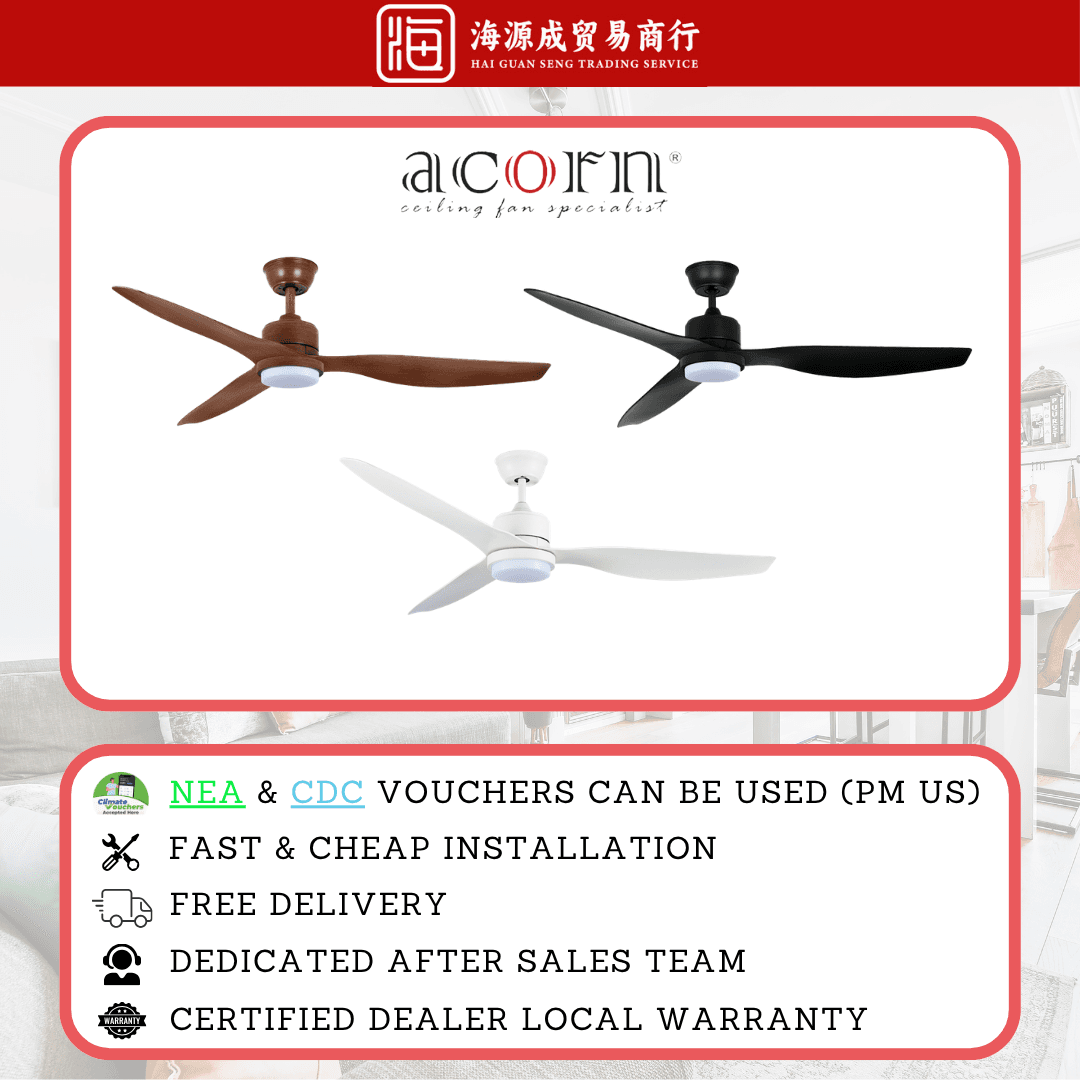
Acorn
Acorn DC-159 40" / 52" DC Ceiling Fan
DC
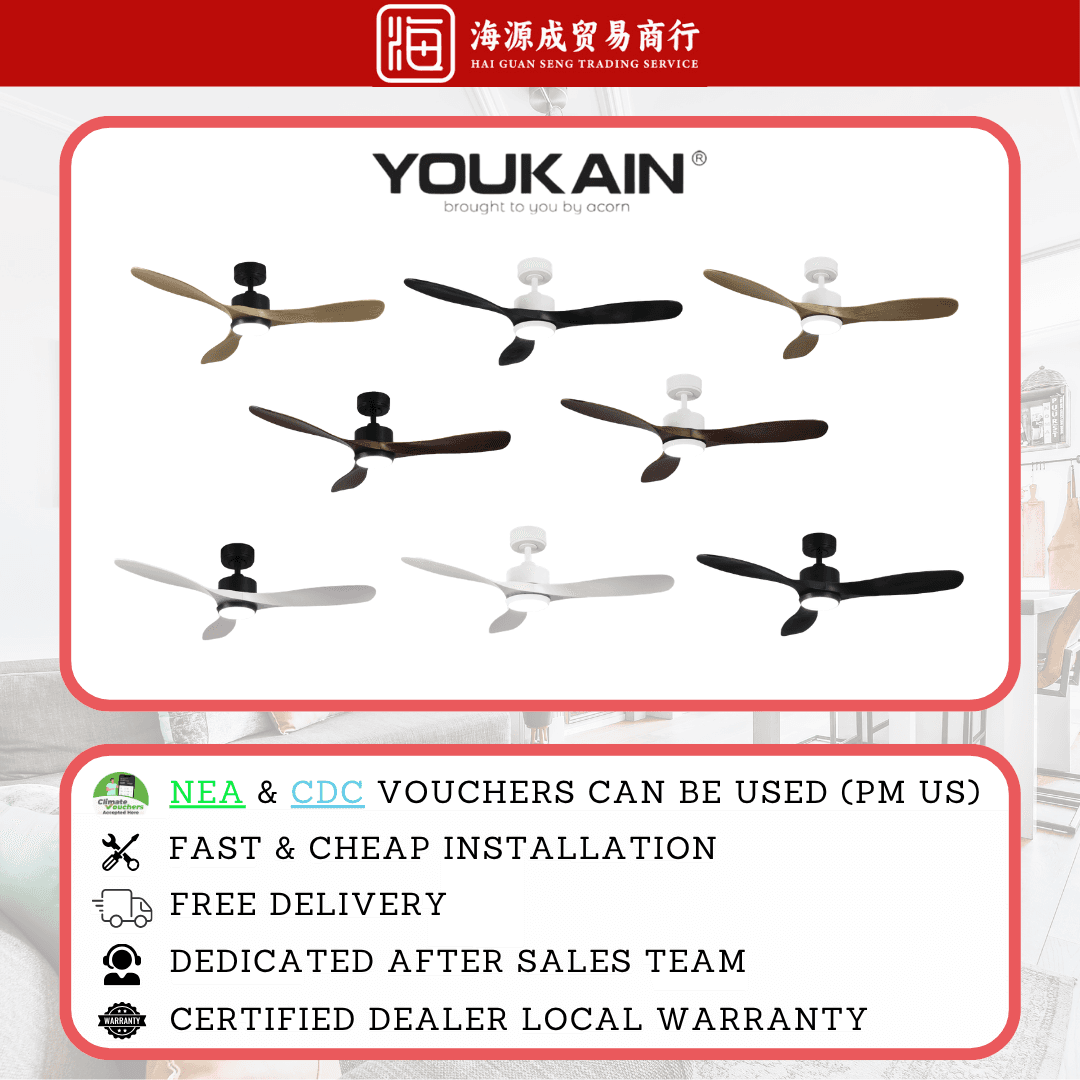
Acorn
Acorn YJ-668 46" / 52" DC Ceiling Fan
DC
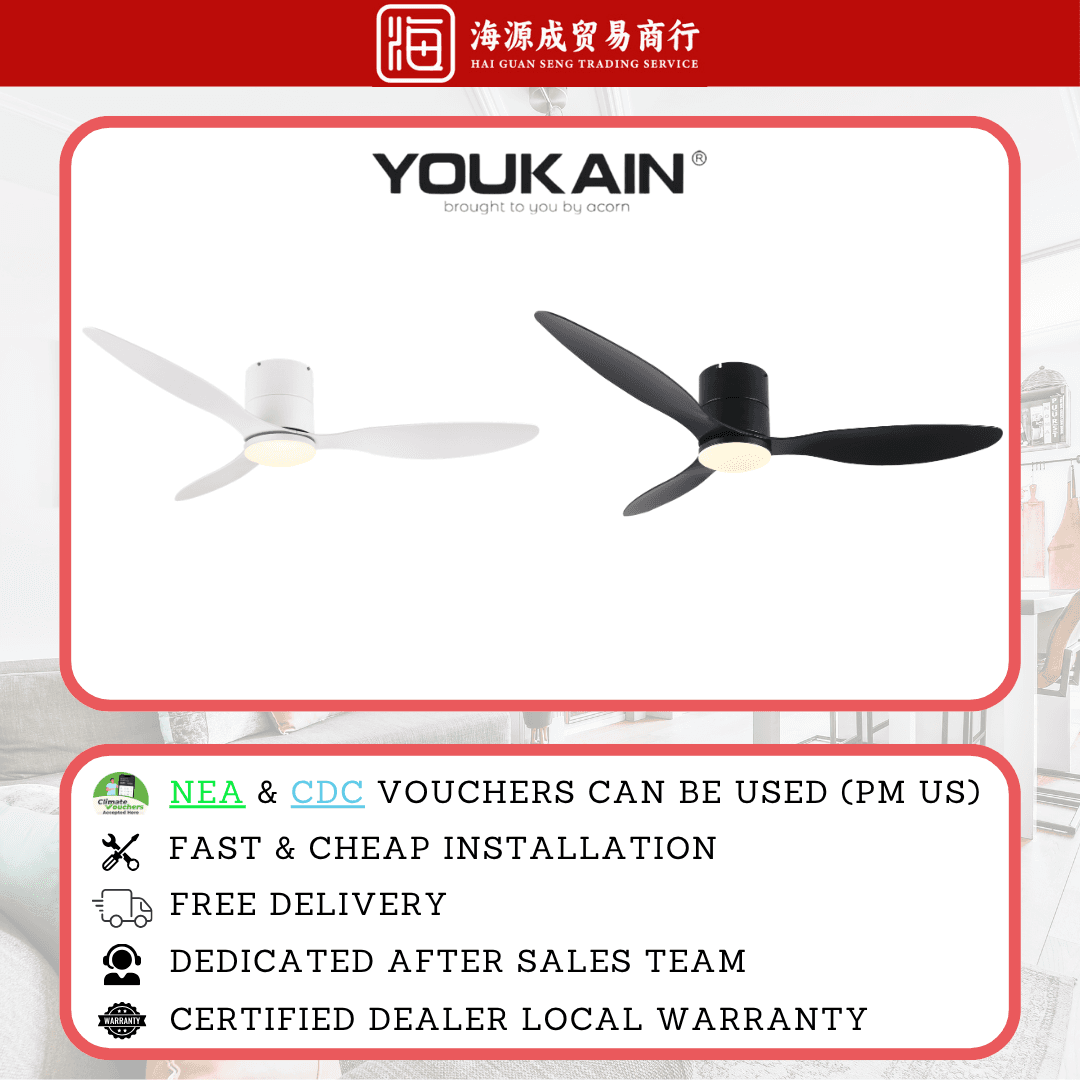
Acorn
Acorn YJ-820H 46" / 52" DC Ceiling Fan
DC
Sorted? If not, ask the counter.
44 years of these questions at 31 Kelantan Lane. WhatsApp us what you are dealing with. A photo or a short video helps. We will tell you straight what it needs, whether or not it means buying anything.