
DC fans · energy · comparison · 9 min read
DC vs AC ceiling fan: Singapore energy cost over 5 years
The maths on your SP utility bill. Why a DC fan pays for itself inside three years for most HDB living rooms, and which models we recommend.
By the Hai Guan Seng team — the folks behind the counter on Jalan Besar · First published 20 Jan 2026, updated 2 Apr 2026
Walk into most electrical shops in Singapore and you'll get pushed toward whichever fan they have on promo. Usually an AC unit because the margin is better. At Hai Guan Seng we stock DC only. Every fan on our shelves, across KDK, Fanco, Crestar, Bestar, Alaska, Acorn, Decco, Mowe, Point One and Spin, runs on a DC motor.
This guide shows the actual numbers, using real spec sheets and current retail prices from KDK Singapore and Courts. The headline finding might surprise you: without the Climate Voucher, DC barely beats AC at high run hours and roughly ties at low run hours. The Climate Voucher is what tips the maths decisively in DC's favour. Read on for the working.
The data we used
Two matched KDK/Fanco pairs, all sourced from the manufacturer's official spec pages and current Courts retail listings:
| Model | Motor | Power draw | Counter price |
|---|---|---|---|
| Fanco B-Star 46" DC | DC, 5 speeds | 5W low → 37W high | S$199 (HGS) |
| KDK M11SU 44" AC | AC, 3 speeds | max 58W | S$196 (Courts) |
| KDK W56WV 56" DC | DC, 9 speeds | 3W low → 39W high | S$368 (HGS) |
| KDK M56SR 56" AC | AC, 3 speeds | max 64W | S$275 (Courts) |
Tariff used throughout: SP Group regulated rate at S$0.30/kWh, the midpoint of the 2026 quarterly band. Adjust ±10% for your actual tariff. All maths uses max-speed wattage for a worst-case bill. Real-world use is lower, especially for DC which scales down to 3 to 5W at speed 1 while AC fans still draw 35W+ at their lowest setting.
Entry pair, bedroom, 4 hours a day
Most customers use a bedroom fan only overnight. 4 hours a day, 365 days a year:
| KDK M11SU AC | Fanco B-Star DC | |
|---|---|---|
| Counter price | S$196 | S$199 |
| Annual kWh | 84.7 | 54.0 |
| Annual electricity cost | S$25.40 | S$16.21 |
| 5-year electricity cost | S$127.02 | S$81.03 |
| 5-year TCO, no voucher | S$323.02 | S$280.03 |
| 5-year TCO, Climate Voucher on DC | S$323.02 | S$81.03 (fan free after voucher) |
DC wins by S$43 over 5 years without voucher. Real, but modest. With voucher, DC wins by S$242 because the S$199 fan is fully covered.
Workhorse pair, 56" living room, 8 hours a day
Living rooms run longer. 8 hours a day at max draw:
| KDK M56SR AC | KDK W56WV DC | |
|---|---|---|
| Counter price | S$275 | S$368 |
| Annual kWh | 186.9 | 113.9 |
| Annual electricity cost | S$56.06 | S$34.16 |
| 5-year electricity cost | S$280.32 | S$170.82 |
| 5-year TCO, no voucher | S$555.32 | S$538.82 |
| 5-year TCO, Climate Voucher on DC | S$555.32 | S$170.82 (fan free after voucher) |
Without voucher: DC wins by S$17 over 5 years. Essentially a tie. The DC fan's higher counter price (S$93 more than the AC) is almost exactly cancelled out by 5 years of lower electricity bills. With voucher: DC wins by S$385.
The honest finding
Without Climate Voucher, DC vs AC is genuinely close. The S$400 voucher is doing most of the work in DC's favour. Anyone telling you DC is "50% cheaper to run, the savings are massive" is overselling. At S$0.30/kWh and realistic run hours, you save S$15 to S$50 a year, not hundreds. The voucher is the killer argument, not the kWh.
Why we still chose DC-only as a shop
Three reasons that don't show up in a 5-year TCO table:
- Real-world wattage is much lower than max. DC fans scale down smoothly. The W56WV at speed 4 of 9 (typical living-room setting) draws around 12W, not 39W. AC fans can't do this. Their lowest speed still sits around 35W. So real bills favour DC further than the max-draw maths suggests.
- Noise. DC motors run under 30dB on low. AC fans hum at ~40dB at the same airflow. Matters in bedrooms.
- Climate Voucher coverage. Every fan we sell is voucher-eligible. We don't want a customer walking out having paid for something the government would have covered.
Where AC still makes sense (and where to buy it)
We don't sell AC. Three legitimate reasons you might still want one, plus where to get it:
- Conservation aesthetic. A few traditional wooden-blade fans for shophouse renovations are AC-only. Try specialist heritage suppliers.
- Like-for-like landlord replacement. If your tenant's AC fan broke and you want to swap it without rewiring the wall dial, the chain stores carry stock. The dial speed switch that came with the original AC fan won't work with a DC controller.
- Urgent same-day install and the DC model you want is on a 2-week wait.
For all three, Courts (KDK M11SU at S$196, M56SR at S$275) and Best Denki have ongoing AC ranges. We won't pretend to be the right shop for that buyer.
Our DC range: what the voucher covers
Every fan we stock is DC and Climate-Voucher eligible. A starting shortlist:
| Need | Pick | Price | After voucher |
|---|---|---|---|
| Bedroom, entry | Fanco B-Star 46" | S$199 | S$0 |
| Bedroom, premium | Fanco Tributo 46" | S$268 | S$0 |
| Workhorse 56" | KDK W56WV 56" | S$368 | S$0 |
| Premium 56" | KDK H56GP 56" | S$568 | S$168 |
| Smart, Wi-Fi | Fanco Rito-5 54" Wi-Fi | S$298 | S$0 |
| Smart, no Wi-Fi | Fanco Rito-5 54" standard | S$238 | S$0 |
| Maximum airflow | KDK U60FW 60" | S$568 | S$168 |
The "After voucher" column assumes the full S$400 Climate Voucher is applied. Anything priced under S$400 ends up at S$0 out of pocket.
The verdict, one paragraph
For a homeowner in 2026 who hasn't yet spent the Climate Voucher: buy DC. The fan is free, it's quieter, it scales smoothly across 5 to 9 speeds instead of 3, and the long-run electricity bill is lower. For a homeowner without voucher to spend, the DC vs AC decision is closer than the marketing claims. At 4 hours a day in a bedroom, AC saves you about S$3 a year over 5 years on counter price. At 8 hours a day in a living room, DC saves you about S$3 a year on running cost. Pick on noise, speed steps and smart features, not just kWh. For landlords and urgent replacements: AC at the chain stores is fine.
FAQ
Does the fan motor really last 10 years?+
Both AC and DC motors are rated 10–15 years of continuous use under normal load. Capacitors (AC) and electronic controllers (DC) are the usual failure points and both are replaceable parts.
Will my electricity bill change immediately if I swap AC to DC?+
Yes, on the next SP bill. A typical 4-room living-room swap (KDK M56SR AC at 64W max to KDK W56WV DC at 39W max, running 8 hours a day) shaves around S$22 a year off the bill at S$0.30/kWh, about S$2 a month.
Are DC fans more likely to break because of the electronics?+
Slightly. The controller (also called the receiver or driver) is the part that fails first. About 5 to 8% of units within 5 years from our counter experience. KDK, Fanco and Crestar all stock replacement controllers as a S$45 to S$80 part. The AC equivalent failure is the capacitor, similar cost and similar frequency.
Can I dim a DC fan's light kit?+
Most DC fans with light kits include dimmable LEDs controlled from the remote. Some entry models like the Fanco B-Star ship with a tri-tone (Day/Warm/Cool) 24W non-dim LED. Check the spec sheet before ordering if dimming matters.
My existing wall switch is the dial-type for an AC fan. Will it work with a DC fan?+
No. DC fans run off a controller that expects continuous mains power; the wall dial that varies voltage will damage a DC controller. The installer will leave your wall switch as on/off and you'll control speed with the supplied remote. No rewiring needed, just the swap.
Does DC use less electricity in standby?+
Marginal, under 1W for non-Wi-Fi DC fans. Wi-Fi DC fans (Fanco Rito-3, Rito-5, Zeno, Reno) sit at ~2W standby, which adds about S$5 a year. Still well inside the savings on running cost.
Is the Climate Voucher worth waiting for if I haven't claimed it yet?+
Takes under 5 minutes to claim on RedeemSG with Singpass. If you're buying a DC fan, claim before you come down. Without the voucher, the DC vs AC gap is much smaller. The voucher is what makes DC the clear winner.
Sources
- KDK W56WV spec: kdk.sg official
- KDK M56SR spec and Courts price: kdk.sg, Courts
- KDK M11SU spec and Courts price: Courts
- Fanco B-Star spec: Home First (Fanco datasheet)
- SP Group regulated electricity tariff, published quarterly at spgroup.com.sg
Talk to the counter
If you want a recommendation specific to your flat, bring the room dimensions, ceiling height, and existing wiring photo. WhatsApp +65 8302 4888. We'll send three DC options across price tiers so you can compare before deciding. See also the HDB sizing guide and the Climate Voucher guide.
From our shelves
Fans mentioned in this guide
Authorised dealer stock, full warranty, Climate Voucher accepted on every DC model at the counter.

Bestar
Bestar Duo Hagar DC Ceiling Fan
DC
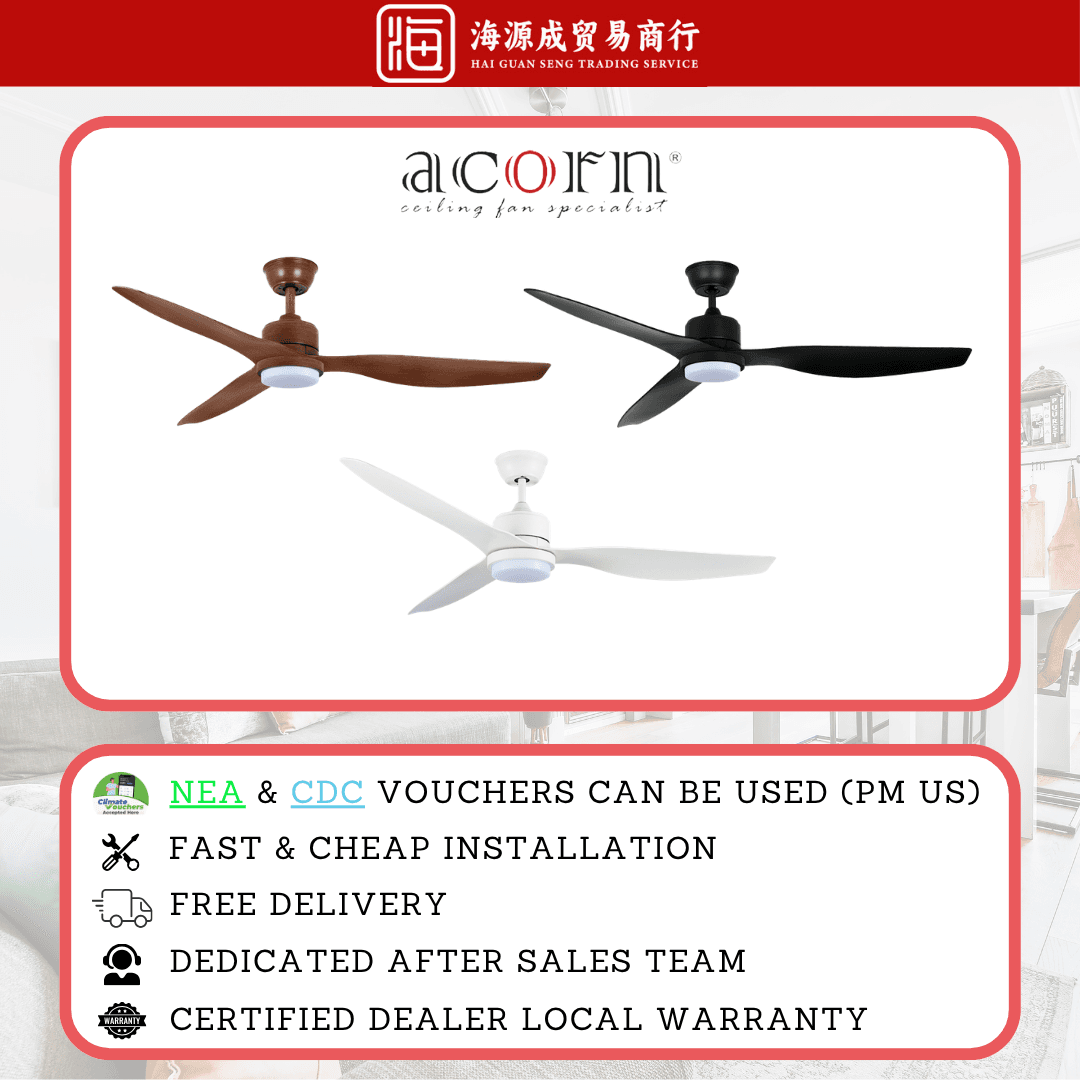
Acorn
Acorn DC-159 40" / 52" DC Ceiling Fan
DC
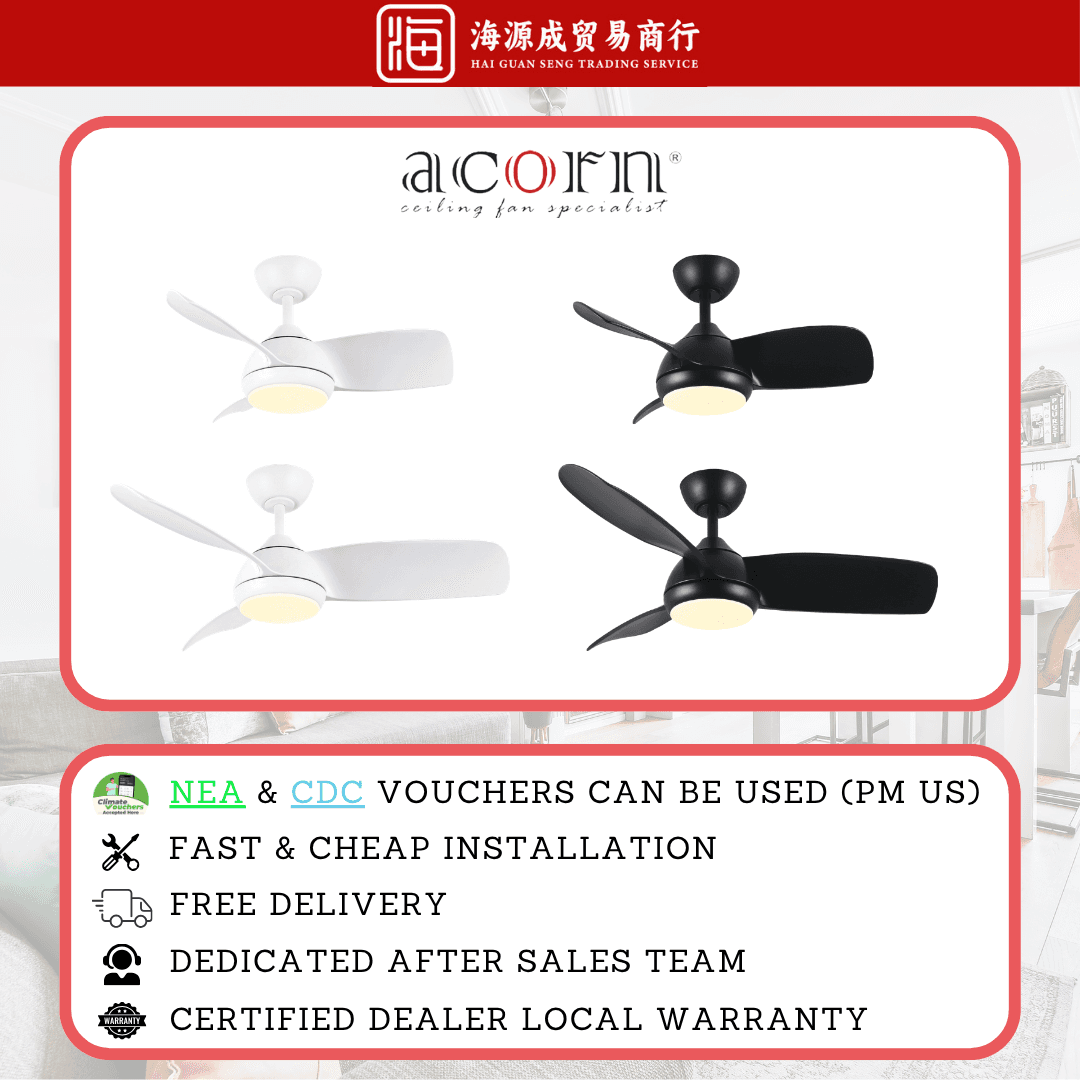
Acorn
Acorn Vigor YJ-717 30" / 42" DC Ceiling Fan
DC
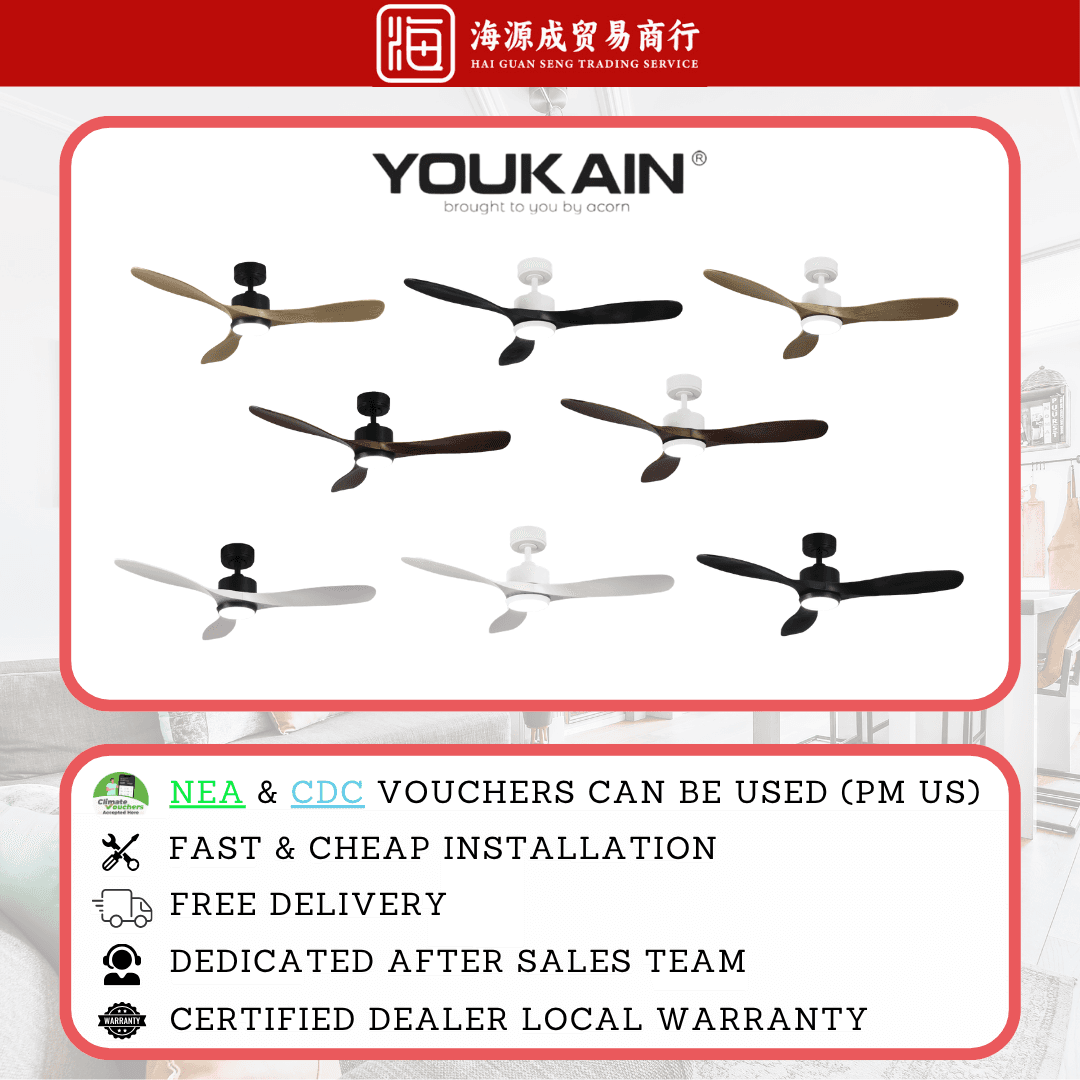
Acorn
Acorn YJ-668 46" / 52" DC Ceiling Fan
DC
Sorted? If not, ask the counter.
44 years of these questions at 31 Kelantan Lane. WhatsApp us what you're dealing with — a photo or a short video helps — and we'll tell you straight what it needs, whether or not it means buying anything.