
installation · ceiling fans · 6 min read
Ceiling fan installation checklist
What a licensed installer checks before hanging a fan. Pre-installation, during, post, and which questions to ask your contractor.
By the Hai Guan Seng team — the folks behind the counter on Jalan Besar · First published 10 Feb 2026, updated 10 Apr 2026
A ceiling fan hung wrong shows up two ways: it wobbles within a week, or it falls in year three. Both are preventable on installation day if you know what the installer should be doing. This guide walks the full sequence: what you do before the installer arrives, the 12 checks they should run on the day, the red flags that mean you stop work, and what to register for warranty afterwards.
Most HDB and condo fan installs in Singapore are straightforward: concrete ceiling, factory-installed hook, swap and go. The cases that go wrong are usually false-plasterboard ceilings, high ceilings (over 2.8m) where the drop rod is wrong, and rewiring jobs where someone other than a Licensed Electrical Worker has touched the cable. The checklist below catches all three.
What our basic installation package covers
Every fan we sell comes with the option of our basic installation package. What's covered, and what triggers add-on charges, is shown below.
Basic installation only
The quoted install covers the basic package below. Any work beyond it (false ceiling, cornice, regulator, ceiling over 2.9m, new electrical point) is chargeable as an add-on.
我们提供的安装报价仅涵盖以下基本安装范围。其他情况(假天花板、檐口、调节器、超过 2.9m 的天花板、新的电源点)需额外收费。
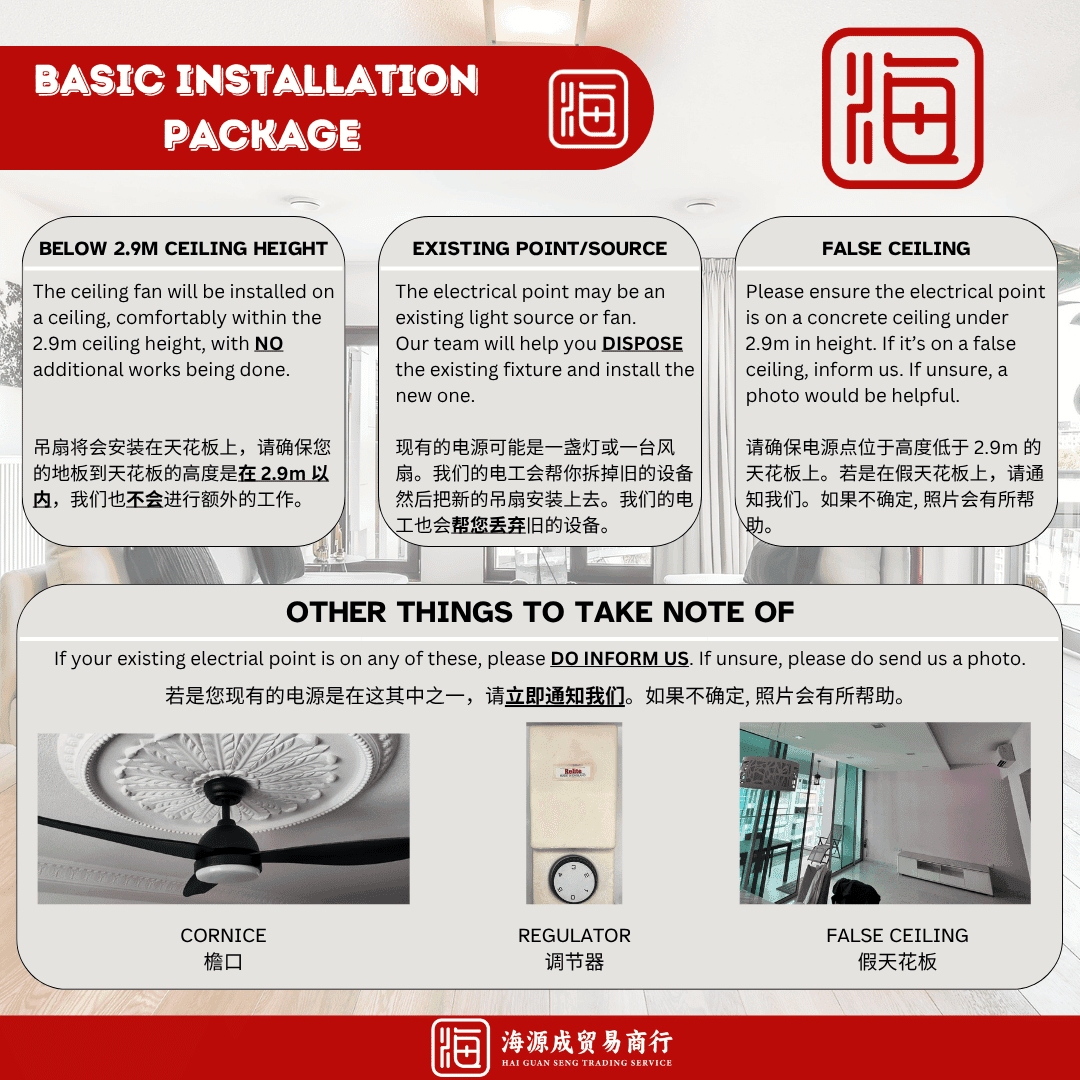
What the basic install covers
BELOW 2.9M CEILING HEIGHT
The ceiling fan will be installed on a ceiling, comfortably within the 2.9m ceiling height, with NO additional works being done.
吊扇将会安装在天花板上,请确保您的地板到天花板的高度在 2.9m 以内,我们也不会进行额外的工作。
EXISTING POINT / SOURCE
The electrical point may be an existing light source or fan. Our team will help you DISPOSE the existing fixture and install the new one.
现有的电源可能是一盏灯或一台风扇。我们的电工会帮你拆掉旧的设备,然后把新的吊扇安装上去。我们的电工也会帮您丢弃旧的设备。
FALSE CEILING
Please ensure the electrical point is on a concrete ceiling under 2.9m in height. If it's on a false ceiling, inform us. If unsure, a photo would be helpful.
请确保电源点位于高度低于 2.9m 的天花板上。若是在假天花板上,请通知我们。如果不确定,照片会有所帮助。
OTHER THINGS TO TAKE NOTE OF
If your existing electrical point is on any of these, please DO INFORM US. If unsure, please send us a photo.
若是您现有的电源是在这其中之一,请立即通知我们。如果不确定,照片会有所帮助。
- CORNICE檐口
- REGULATOR调节器
- FALSE CEILING假天花板
WhatsApp us a photo of your ceiling before install day so we can flag any extras and quote them upfront.
Before the installer arrives: your 6 jobs
These take 10 minutes and they make the install go faster.
- Photo the existing fan point. Wide shot of the ceiling, close-up of the hook or junction box, and a shot of the wall switch. Send to the installer ahead of time so they know what bracket and screws to bring.
- Confirm the ceiling type. Tap the ceiling around the fan point. Hollow sound = false plasterboard ceiling. Solid thud = concrete. Plasterboard requires bracket reinforcement above the ceiling, which is a different scope of work. Tell the installer before they arrive.
- Measure the ceiling height. Floor to ceiling, in centimetres. This determines drop rod choice. See the HDB sizing guide for why this matters.
- Clear the floor under the fan point. 2-metre radius. Move the dining table, the rug, anything fragile. Installers bring drop sheets but bare floor is faster.
- Have the box ready. Don't unbox until the installer is there. They'll want to confirm parts before opening, and an unboxed fan with missing parts is harder to return.
- Climate Voucher already redeemed at the shop. The voucher scan happens in-store before the fan leaves, not at install. If you haven't redeemed yet, do that first.
On the day: the 12 checks the installer should run
This is the installer's job, not yours. But you should be in the room watching, and you should know what to look for.
Pre-mount (4 checks)
- Power off at the DB box. Not just the wall switch. The dedicated circuit at the consumer unit. Cover the trip switch with tape so nobody flips it back on.
- Multimeter test for live cable. Touch the live wire and the neutral wire with a probe. Should read 0V. If it reads anything, the wrong breaker was flipped.
- Inspect the existing ceiling hook. HDB factory hooks are rated for typical ceiling fan loads. Worth a visual check for rust, paint cracking around the base, or any visible movement. If the hook looks tired, replace it (S$15–S$30 part).
- Confirm the rod situation. Nearly every fan ships with the same 5" drop rod, about 30cm from ceiling to bottom of fan. That works for 2.6 to 2.8m ceilings. For 2.4m and below, you should already have ordered a hugger series fan (no rod, mounts flush). For 3m+ ceilings, you should already have ordered a longer rod extension at point of sale. If the installer arrives and the rod is wrong for the ceiling, stop. Sort it before mounting.
Mount (5 checks)
- Hang from the manufacturer hook only. Not a self-driven anchor. Not a cable tie. Not a re-used hook from another fan. The factory hook is part of the structural ceiling slab; replacements must go back into the same anchor point.
- Use the supplied bolts, washers and lock nuts. Don't substitute. The torque rating on the supplied hardware is matched to the motor housing weight.
- Earth wire connected. Green/yellow wire from the fan motor housing must go to the earth terminal in the ceiling junction box. If your existing ceiling point doesn't have an earth wire (older flats sometimes don't), the installer should flag it before mounting. Not after.
- Balance check before power-up. Manufacturer ships small balance weights in a bag inside the box. Installer attaches one to a blade tip, spins the fan by hand, listens for symmetry. Skipping this is the #1 cause of week-one wobbles.
- Remote receiver inside the canopy, not dangling. The receiver module fits inside the housing canopy. If it's loose, it'll buzz at low speeds and eventually short.
Power-up (3 checks)
- Run on all speeds, both directions. 1 to 9 (DC) or 1 to 3 (AC). Listen for ticking, hum, or wobble. Reverse mode should be tested even if you'll never use it. A fan that reverses incorrectly was wired wrong.
- Pair the remote. Single press should work from anywhere in the room. If the remote needs to be held up to the canopy to register, the receiver antenna is folded inside the housing. Installer needs to re-open and dress the wire.
- Hand over the manual, remote, and warranty card. Don't accept a "you can download it from the website." The warranty card needs the installation date written on it, signed by the installer, for any claim.
Red flags: stop work if you see these
Five things that mean the install is not safe to complete. Tell the installer to stop, document with photos, and call the shop.
- Installer skips the multimeter test and just trusts the wall switch is off. Power-on errors during install are how installers get electrocuted.
- Mounting to plasterboard without a reinforcement bracket above the ceiling. Plasterboard cannot hold a 5kg spinning fan. The fan will pull through in 6–24 months.
- No earth wire connection. Not optional. Singapore Wiring Code requires earthing on appliances with metal housings, and most ceiling fans have metal canopies and housings.
- No drop rod on a 2.8m+ ceiling. Fan blades end up too high; airflow goes across the ceiling, not down. The fan will still work but you'll feel almost no breeze.
- Refuses to balance the blades. "It's fine, modern fans don't need balancing." They do. Walk away from this installer.
What it should cost
| Job | Singapore typical | Notes |
|---|---|---|
| Standard install, concrete ceiling, factory hook, no rod swap | S$80–S$120 | Most HDB fan swaps |
| Longer drop rod extension (for 3m+ ceilings) | Order-in part + labour | Around 1-day lead, tell us at point of sale |
| Replace tired ceiling hook | +S$15–S$30 | Part + labour |
| Plasterboard ceiling, bracket reinforcement | +S$50–S$100 | Plus labour to open up false ceiling |
| New fan point (wiring from scratch) | S$150–S$300 | Needs a Licensed Electrical Worker (LEW), not just an installer |
| Remove + dispose old fan | +S$10–S$20 | Some installers include free |
Hai Guan Seng's install team quotes per job on WhatsApp before the day. We don't bundle install into the fan price because every flat is different.
Questions to ask before booking the installer
Six questions. If the answer to any is "don't worry about it," book a different installer.
- "Are you using the manufacturer hook, or installing your own anchor?"
- "What drop rod length will you use for my ceiling height?"
- "Will you earth the fan to the ceiling junction box?"
- "Do I get a written warranty on the installation labour, separate from the fan warranty?"
- "Is the trip charge included, or extra if you're already in the area?"
- "If something goes wrong in the first month, do you come back free?"
Warranty: what to register, and within what window
After the installer leaves, register the fan with the manufacturer. Warranty terms vary across KDK, Fanco, Crestar and the rest of our range, so check the card in the box for your specific model. Most brands require registration within 14 to 30 days of purchase or install. Register online via the brand's official site (kdk.sg, fanco.com.sg, crestarfan.com.sg) or mail the card included with the fan.
Keep four things together for the next 1 to 5 years:
- The receipt from Hai Guan Seng. This is proof of authorised-dealer purchase and is required for any warranty claim.
- The Climate Voucher redemption SMS or email.
- The signed installation warranty card from the installer.
- A photo of the model number and serial number sticker on the fan canopy.
FAQ
Can I install the fan myself?+
Technically yes, if you turn off the breaker and follow the manual. Three reasons most people don't: working overhead with electrical cables is awkward and dangerous; the balance check is hard to do alone; and an uninstalled fan that arrives with damage is the customer's responsibility, an installer who unboxes for you transfers that liability to them.
How long does an install take?+
Standard swap: 30–45 minutes. New fan point (rewiring): 1.5–3 hours. Plasterboard reinforcement: half a day plus a second visit for paint touch-up.
Does Hai Guan Seng do installation?+
We work with a team of licensed installers and book the appointment for you when you buy the fan. WhatsApp us the day you collect to schedule. We don't carry out the install ourselves, different trade.
Will the installer drill into my ceiling?+
Only if the existing hook needs replacement or you're moving the fan point. A straight swap onto the factory hook involves no drilling.
What if my existing wall switch is the dial-type for an AC fan?+
The installer will disconnect the dial and leave it as a permanent on/off, you'll control speed with the remote. No rewiring needed.
Do I need a Licensed Electrical Worker for the install?+
No, for a fan swap onto an existing point. Yes, for any new wiring, moving a fan point, or running cable through a wall. The LEW credential is checked by HDB / BCA if you're caught after a major incident; if you've used a non-LEW for new wiring and there's a fire, your insurance won't pay.
What if the fan wobbles after the installer leaves?+
Immediately after install: not balanced properly. Call them back. After a week or two: a blade screw is loosening. Re-tighten yourself or call the installer. After a year or more: the hook is moving in the ceiling. Get an LEW to check the anchor.
Talk to the counter
If you're buying a fan and need install in the same week, WhatsApp +65 8302 4888. Tell us the flat type, ceiling height, and existing fan point situation (or send a photo) and we'll schedule the installer to come the day you collect the fan. See also the HDB sizing guide for picking the right blade span before you order, and the Climate Voucher guide for paying with voucher first.
From our shelves
Fans mentioned in this guide
Authorised dealer stock, full warranty, Climate Voucher accepted on every DC model at the counter.

Bestar
Bestar Duo Hagar DC Ceiling Fan
DC

Acorn
Acorn DC-159 40" / 52" DC Ceiling Fan
DC
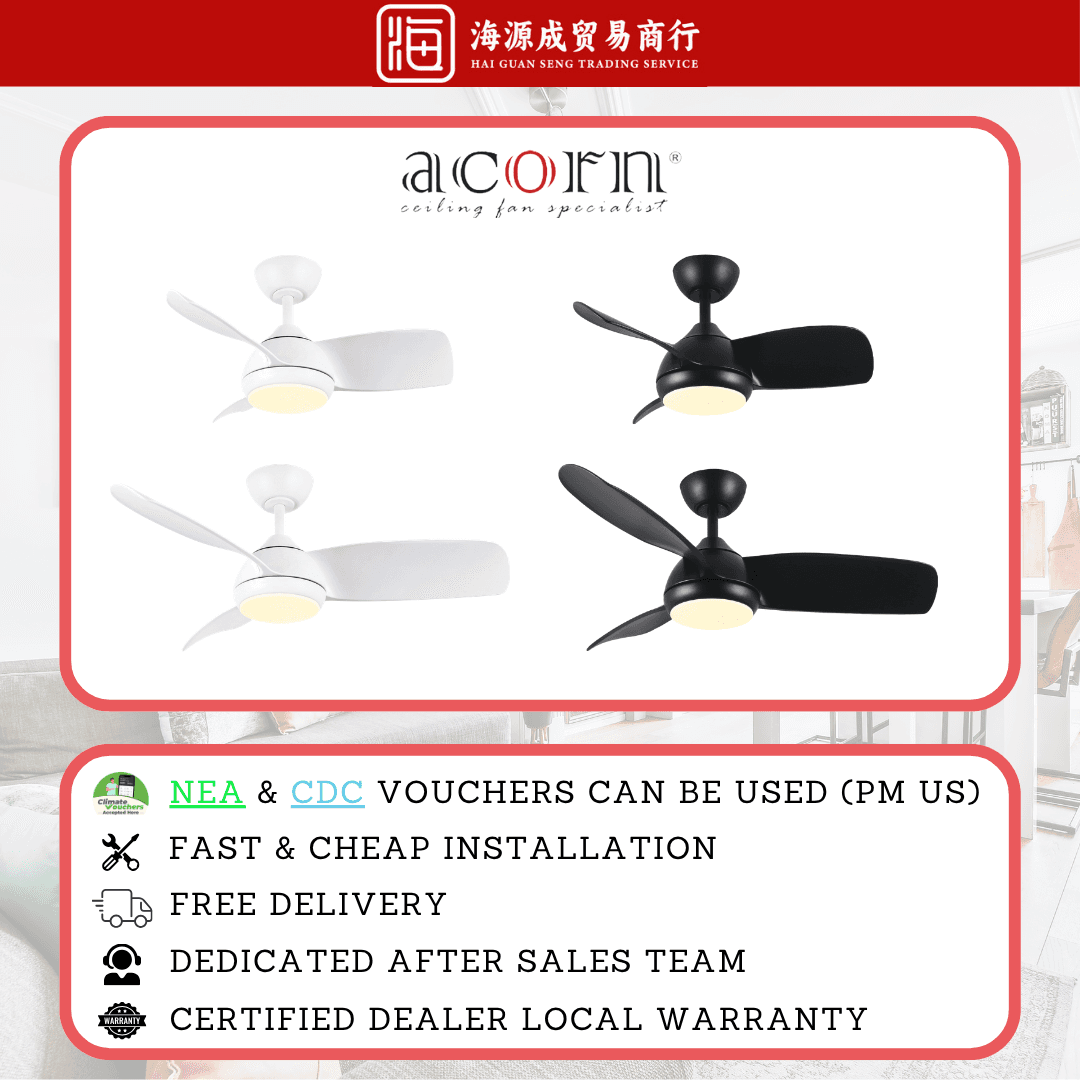
Acorn
Acorn Vigor YJ-717 30" / 42" DC Ceiling Fan
DC

Acorn
Acorn YJ-668 46" / 52" DC Ceiling Fan
DC
Sorted? If not, ask the counter.
44 years of these questions at 31 Kelantan Lane. WhatsApp us what you're dealing with — a photo or a short video helps — and we'll tell you straight what it needs, whether or not it means buying anything.